

A featured contribution from Leadership Perspectives: a curated forum reserved for leaders nominated by our subscribers and vetted by the Construction Tech Review Advisory Board.

Macdonald Lucas
Facility Management is a Sector Ripe for Digital Disruption

Donald Macdonald
Facilities Management (FM) comprises those activities that support the core business, but which are a poor fit with the expertise of the host organization. Typically, it includes cleaning, catering, and maintenance. However, the exact range of FM services varies from organization to organization.
For example, a food manufacturer may decide that hygiene issues are too closely entwined with their reason for being and consequently treat cleaning as core business. But in many other facilities cleaning is non- core business.
How Typical FM Contracts Discourage Digital Disruption
For some time, FM has been outsourced, initially via single service contracts. More recently via multi-service ‘bundled’ contracts. These contracts have historically been labor-intensive with little IT investment except:
• CMMS’s (computerized maintenance management systems) which assist with contract administration;
• BMS’s (building management systems) which help control building systems (e.g. heating and ventilation); and,
• In-field devices for works status reporting and asset data collection.
Traditional FM contracts are typically several years-long often with an initial period of say three or five years followed by contract extensions in one, or, two- year increments. Public-private partnership’s (PPP), a popular contracting model for major public sector assets like hospitals, schools and, prisons can be for twenty- five years or longer. Generally speaking, FM bid costs are high and profits low.
Digital disruption may be described as a transformation caused by emerging digital technologies and business models that impact the value of exiting models and services. There are a variety of reasons why FM has not experienced the level of digital disruption that other industries have.
Where, FM is delivered by in-house teams, as it sometimes is, funding requests for FM initiatives are always likely to come second to funding requests for core business initiatives.
Where it is outsourced:
• Long term contracts preclude the competitive tension that commonly drives change;
• High bid costs and low profits make funding the cost of change challenging; and
• If the ROI is unlikely to be achieved by the perceived contract end date the business case is difficult to support.
Opportunities for Digital Disruption in FM
There are several opportunities for FM to become digitally disruptive they include:
• A shift to FM demonstrably acting as a value driver rather than a cost burden to their host organization;
• FM finding a way to unlock funding for research and development;
• The elimination of labor- intensive activities that add no value to the FM process;
• Efficient interfacing of FM related IT systems;
• Better analysis of how asset populations perform and deteriorate in situ; and,
• The ability to optimize whole of life asset costs by better understanding the interrelationship between planned maintenance, reactive maintenance, and life cycle replacement.
Macdonald Lucas has been privileged to work on two current FM initiatives that are truly digitally disruptive.
IoT Initiative
A major FM contract for FIFO villages (fly in fly out accommodation for itinerant workers in the utilities industry) in remote Australia saw the deployment of over 17,000 IoT sensors to bedrooms and common areas. These devices ensured the heating, ventilation and air conditioning systems ran optimally. Consequently, utilities consumption and wear and tear was minimized, risk of asset failure reduced and asset life extended.
Monitoring asset performance for issues like overheating and excessive vibration enabled a shift from planned maintenance to a condition-based maintenance model with maintenance carried out when required rather than in response to a strict calendar of activities.
The same contract, saw air conditioning, triggered by environmental measures like ambient temperature and relative humidity, being automatically switched on or off as appropriate when rooms were empty. This negated risks like mould growth, condensation and similar.
As it was included in the tender price the initiative was affordable, and being a new contract there was no cost of change. Also, competitive tension favoured it. This was because the remote, distributed, disaggregated portfolio being serviced made it a more cost-effective model than the more traditional labor- intensive ones proposed by the competition.
This initiative may be considered disruptive as it eliminated expensive labour- intensive asset maintenance activities that are currently the bedrock of most FM contracts and it leveraged technology to optimise asset performance.
Life Cycle Modelling
A significant FM challenge is accurate budgeting for life cycle works (asset replacement at the end of design life) e.g. failed boilers, pumps, and air conditioning units.
Life cycle modeling typically uses deterministic, linear modelling which is an inaccurate method of predicting asset failure.
An Australian university has developed a web enabled life cycle estimating tool that uses probabilistic statistical analytical techniques including Markov Chain, Monte Carlo, and genetic algorithms to calculate degradation curves that model far more accurately asset life. These curves are applied at individual asset level and become more accurate over time as data regarding changing asset condition is periodically uploaded.
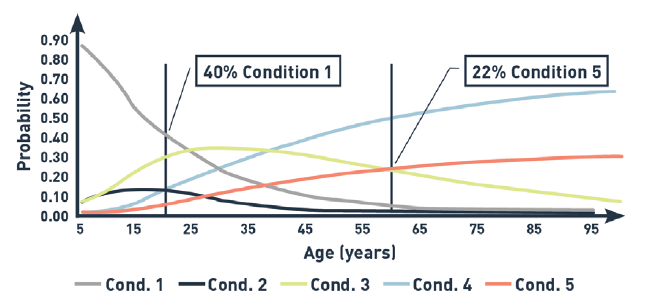
A sample degradation curve
Reasons why this work is digitally disruptive include:
• By working with the tertiary education sector, whose core business is innovation, the limitations imposed by constrained R&D budgets has been broken;
• A methodology to accurately model asset deterioration has been developed; and,
• The ability to accurately model the whole of life costs is now one step closer.
Conclusion
These two projects send a clear message to the wider FM industry. Service providers that lock themselves into old fashioned models and to methods that are constrained by the limitations of current contracts, do so at their peril. They risk going the same way as other victims of digital disrupters, as more innovative thinkers enter the industry.
• Efficient interfacing of FM related IT systems;
• Better analysis of how asset populations perform and deteriorate in situ; and,
• The ability to optimize whole of life asset costs by better understanding the interrelationship between planned maintenance, reactive maintenance, and life cycle replacement.
Macdonald Lucas has been privileged to work on two current FM initiatives that are truly digitally disruptive.
IoT Initiative
A major FM contract for FIFO villages (fly in fly out accommodation for itinerant workers in the utilities industry) in remote Australia saw the deployment of over 17,000 IoT sensors to bedrooms and common areas. These devices ensured the heating, ventilation and air conditioning systems ran optimally. Consequently, utilities consumption and wear and tear was minimized, risk of asset failure reduced and asset life extended.
Monitoring asset performance for issues like overheating and excessive vibration enabled a shift from planned maintenance to a condition-based maintenance model with maintenance carried out when required rather than in response to a strict calendar of activities.
The same contract, saw air conditioning, triggered by environmental measures like ambient temperature and relative humidity, being automatically switched on or off as appropriate when rooms were empty. This negated risks like mould growth, condensation and similar.
As it was included in the tender price the initiative was affordable, and being a new contract there was no cost of change. Also, competitive tension favoured it. This was because the remote, distributed, disaggregated portfolio being serviced made it a more cost-effective model than the more traditional labor- intensive ones proposed by the competition.
This initiative may be considered disruptive as it eliminated expensive labour- intensive asset maintenance activities that are currently the bedrock of most FM contracts and it leveraged technology to optimise asset performance.
Life Cycle Modelling
A significant FM challenge is accurate budgeting for life cycle works (asset replacement at the end of design life) e.g. failed boilers, pumps, and air conditioning units.
Life cycle modeling typically uses deterministic, linear modelling which is an inaccurate method of predicting asset failure.
An Australian university has developed a web enabled life cycle estimating tool that uses probabilistic statistical analytical techniques including Markov Chain, Monte Carlo, and genetic algorithms to calculate degradation curves that model far more accurately asset life. These curves are applied at individual asset level and become more accurate over time as data regarding changing asset condition is periodically uploaded.
A sample degradation curve
Reasons why this work is digitally disruptive include:
• By working with the tertiary education sector, whose core business is innovation, the limitations imposed by constrained R&D budgets has been broken;
• A methodology to accurately model asset deterioration has been developed; and,
• The ability to accurately model the whole of life costs is now one step closer.
Conclusion
These two projects send a clear message to the wider FM industry. Service providers that lock themselves into old fashioned models and to methods that are constrained by the limitations of current contracts, do so at their peril. They risk going the same way as other victims of digital disrupters, as more innovative thinkers enter the industry.
See More: Top Facility Management Companies
The articles from these contributors are based on their personal expertise and viewpoints, and do not necessarily reflect the opinions of their employers or affiliated organizations.
